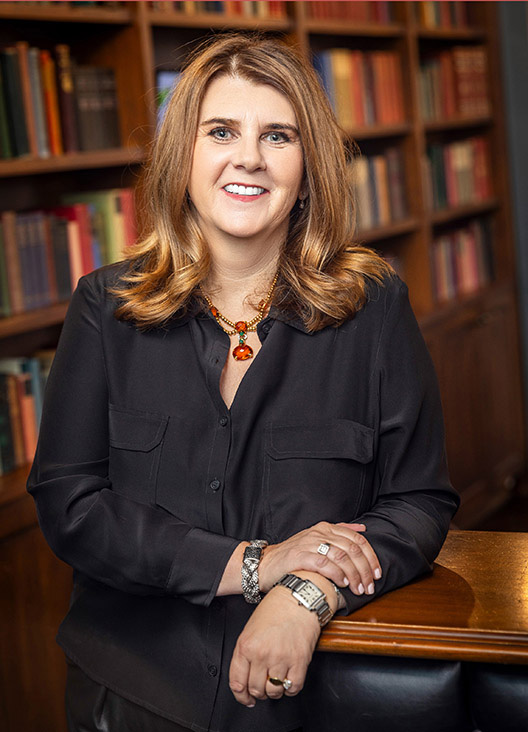
Germany, first
Ela was born and raised in Germany and lived there until she was 21 — long enough for German to be not just her native language but her native way of thinking: about contracts, about craftsmanship, about what a home is supposed to be. She studied at the Justus Liebig University in Giessen before the Atlantic entered the picture.
“When I speak of home, I speak of a small town outside Frankfurt. Woods, open fields, and castles everywhere — there is one from the year 1000 where I used to play. And you are still only ten minutes from anything you could possibly need.”
Europe was not something she read about. Summers were three weeks somewhere on the continent — hiking in Austria and Switzerland, the Croatian coast, the Baltic, exchange programs in France and England. The south of France still has a hold on her: the lavender, the Mistral, the market stalls of bread and cheese. When a client says they are coming from Munich or Milan or Marseille, she has a picture of what they are leaving.
The crossing — 1990
In 1990 she came to Cincinnati — and stayed. Everything this site explains to European newcomers, she once faced without a guide: a credit system that had never heard of her, contracts in a second language, a home purchase with no Notar in sight. The pages you are reading are, in a sense, the guide she did not have.
What brought her was a school year in the United States — and the man she met during it. For the next three years she crossed the Atlantic back and forth between Cincinnati and Germany while finishing her marketing and finance degree at the Justus Liebig University in Giessen. She knows the particular exhaustion of a life lived in two countries at once, because she lived it before she chose one.
And she is honest about the landing, which is the part most people leave out:
“The first few months were very hard. I didn’t realize that people didn’t always say what they meant — everyone wanted to have coffee with you, everyone wanted you to come over. It took me a while to figure out that that is just something people say. Those first months were much harder than I ever expected. But I made it through, and so can you.”
Why Cincinnati kept her
More than three decades later, Cincinnati is home. Here she earned her MBA in Finance and Marketing at the University of Cincinnati’s Lindner College of Business, and here she built a 22-year career as a REALTOR® — over $150 million in transactions with Sibcy Cline, the region’s largest independent brokerage. When she walks a European client through an American closing, she is not translating from a textbook. She is remembering.
The plain answer is that a life took root here. Her husband’s medical practice is in Cincinnati. Four children were raised and schooled here before scattering to four different colleges. And in 2001 she and her husband built a house — which is, in the end, what settled the question.
“Cincinnati is an amazing place to raise a family. It’s the typical Midwestern city, where people are friendly and kind and truly care about you. The traffic is so manageable compared to most big cities. We have all the professional sports, the arts are amazing, and people really care about this city — which also has a very strong German heritage. Building our house in 2001 is what made this city my home, because that is where we raised our children.”
What she knows that a relocation packet doesn’t
The credit score will offend you
This is the wall almost every European buyer hits first, and Ela hit it too:
“To get a loan you need a credit score, and to get a credit score you need to have had debt — which runs against everything most Europeans believe. Europeans are proud of having no credit card debt; many prefer debit cards entirely. But here you have to carry debt to build a score, and that makes no sense to a European buyer. Why should your score be better the more you owe? I still think the system is flawed, because it never looks at your assets. I thought so when I arrived, and I think so today.”
She will not pretend it makes sense. She will tell you how to get around it — which lenders write foreign-national and expat loans, and what to start building the week you land.
If you are bringing children
“I wish parents knew how different school is here. In Germany everything is more relaxed. Here the children are very overscheduled — from middle school on, parents worry about which activities will get them into a good college, and push them into sports for the same reason. It can feel like the whole childhood is aimed at getting into the best college. In Europe, admission is based on your grade point average alone. Your extracurriculars have zero impact.”
She raised four children through this system. When she talks you through school districts, she is not reading a ratings website — she is telling you what the next ten years will actually feel like.
How she works
Ela has guided many families relocating here from Europe and Asia — helping them work out what actually matters to their household before pointing them at a single neighborhood. She is still in touch with many of them. Ask her what the job really involves and the answer is not about houses:
“Buying a home is incredibly stressful. There is so much to think about and worry about. I have done this so many times that I can promise you: I will hold your hand the whole way. I will help you step by step. You will never be alone. You will never have to make a decision by yourself.”
In practice that means you will not wait days for an answer. Questions get answered when you ask them — across six time zones, in either language.
And when your cousin flies in from Germany and asks what there is to see? She will send you to Findlay Market — “because it has a very European feel, and I love going there” — then to the parks, down to the river, and out to something good for dinner.